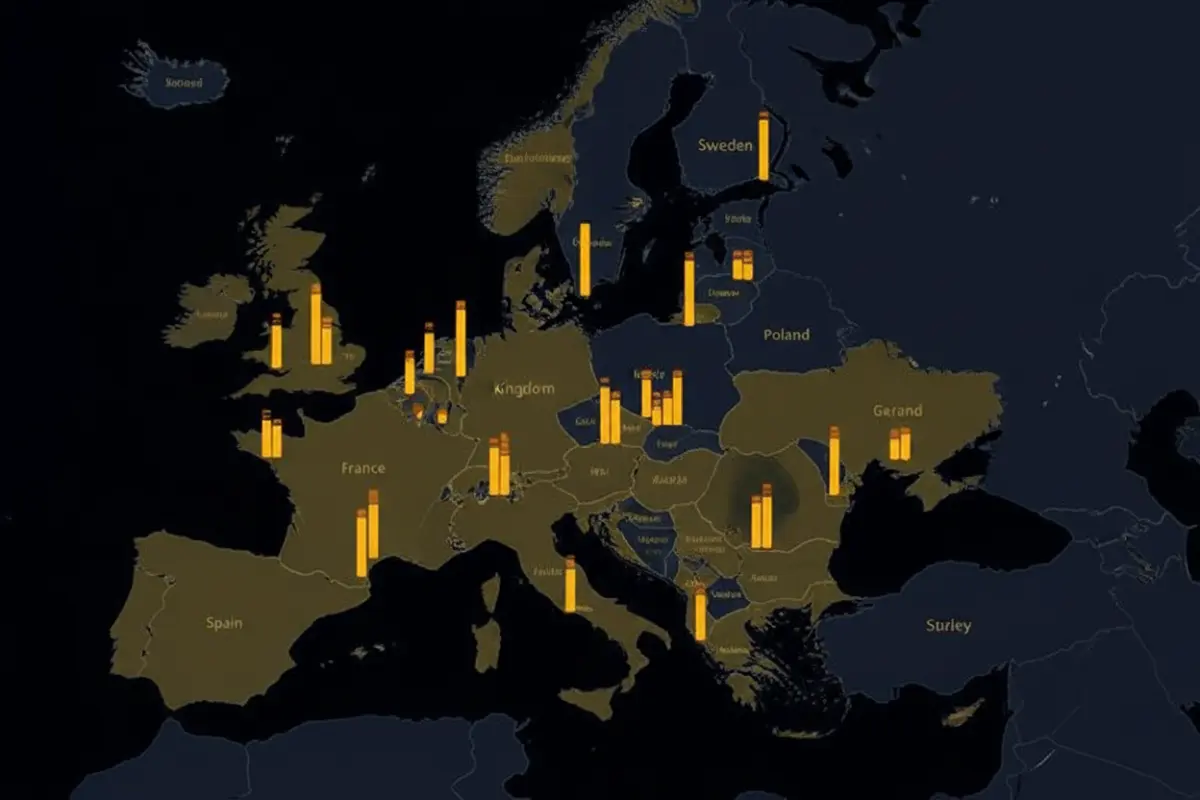
The minimum wage landscape across the European Union continues to evolve in 2026, with significant increases in several member states following the EU Minimum Wage Directive. Honestly, if you're planning to move, work, or hire across borders in the EU this year, understanding these figures is non-negotiable. This article provides a comprehensive, up-to-date overview of statutory minimum wages across all 27 EU countries — and what they actually mean for workers on the ground.
Countries With Statutory Minimum Wages
As of 2026, 22 EU member states have a statutory minimum wage. Here is the complete ranking:
Top 10 Highest Minimum Wages
| Rank | Country | Monthly Gross (€) | Hourly (€) |
|---|---|---|---|
| 1 | Luxembourg | €2,771 | €16.02 |
| 2 | Netherlands | €2,295 | €14.71 |
| 3 | Germany | €2,343 | €13.90 |
| 4 | Belgium | €2,112 | €12.00 |
| 5 | Ireland | €2,391 | €14.15 |
| 6 | France | €1,867 | €12.31 |
| 7 | Spain | €1,381 | €7.60 |
| 8 | Slovenia | €1,278 | €7.37 |
| 9 | Portugal | €1,073 | €6.17 |
| 10 | Greece | €1,027 | €5.08 |
Remaining Countries
| Rank | Country | Monthly Gross (€) |
|---|---|---|
| 11 | Malta | €994 |
| 12 | Lithuania | €1,153 |
| 13 | Estonia | €886 |
| 14 | Poland | €1,139 |
| 15 | Czechia | €924 |
| 16 | Croatia | €1,050 |
| 17 | Slovakia | €915 |
| 18 | Latvia | €780 |
| 19 | Hungary | €838 |
| 20 | Romania | €795 |
| 21 | Cyprus | €1,088 |
| 22 | Bulgaria | €620 |
Countries Without Statutory Minimum Wages
Five EU countries do not have statutory minimum wages, relying instead on collective bargaining agreements:
- Denmark — Average negotiated minimum: ~€3,160/month
- Sweden — Average negotiated minimum: ~€2,600/month
- Finland — Average negotiated minimum: ~€2,400/month
- Austria — Average negotiated minimum: ~€1,850/month
- Italy — Average negotiated minimum: ~€1,300/month
What most people don't realize is that despite lacking statutory minimums, these countries often have higher effective minimum wages than their neighbors. The secret? Strong union coverage — in Denmark, for instance, over 80% of workers are covered by collective agreements. So while there's no "official" number the government sets, the floor is actually higher in practice.
The EU Minimum Wage Directive
The EU Directive 2022/2041 on adequate minimum wages, now fully implemented in 2026, requires:
- Adequacy assessment: Minimum wages must be adequate relative to the national wage distribution and cost of living
- Regular updates: At least every two years using clear, stable criteria
- Reference values: Countries should consider the 60% of median wage or 50% of average wage benchmarks
- Collective bargaining promotion: Countries must promote collective bargaining coverage above 80%
From what we've seen across EU countries, this directive has been a game-changer. Portugal, for example, went from €820 in 2023 to €1,073 in 2026 — that's a 12% jump in just two years. For a country with traditionally low wages, that's transformative for millions of workers.
Purchasing Power Comparison
Raw minimum wage figures do not tell the whole story. A €2,771 minimum wage in Luxembourg sounds incredible, but when you factor in that a one-bedroom apartment in Luxembourg City costs €1,800/month, the picture changes quickly.
When adjusted for purchasing power (PPP), the ranking shifts significantly:
- Luxembourg: Still highest, but the gap narrows considerably
- Germany: Strong purchasing power, especially in eastern regions
- Netherlands: Good value outside Amsterdam and Rotterdam
- France: Middle of the pack after cost adjustment — Paris is expensive, but smaller cities are surprisingly affordable
- Portugal: Despite the lowest minimum wage in Western Europe, costs in cities like Porto and Braga make it stretch further than you'd expect
Use our cost of living simulator to compare what your salary actually buys in different EU cities.
Year-over-Year Changes
Notable increases for 2026:
- Germany: +4.2% (€82/month increase)
- Spain: +5.1% (€57/month increase)
- Portugal: +6.5% (€53/month increase)
- Poland: +8.7% (€64/month increase)
- Romania: +9.2% (€49/month increase)
Eastern European countries continue to see the largest percentage increases, which makes sense — they're catching up to Western levels. In practice, this means countries like Poland and Romania are becoming increasingly attractive for workers who can work remotely at Western salaries while enjoying Eastern costs of living.
How Minimum Wage Affects Net Salary
Here's where things get really interesting. The gap between gross minimum wage and take-home pay varies dramatically due to different tax and social contribution rates:
- Belgium: 42% effective tax rate on minimum wage (the highest in the EU — yes, really)
- Germany: 35% effective rate, though mini-jobs and tax class combinations can reduce this
- France: 22% effective rate — surprisingly low due to generous employment tax credits (the "prime d'activité")
- Portugal: 11% effective rate on minimum wage — one of the most worker-friendly systems at this income level
This is why looking at gross wages alone is misleading. A Portuguese worker earning €1,073 gross keeps roughly €953, while a Belgian worker earning €2,112 might only take home about €1,225. The ratio is very different from what the gross numbers suggest.
Use our net salary calculator to see exactly what you'd take home at minimum wage in any EU country.
What About Part-Time Workers?
Something that often gets overlooked in minimum wage discussions is the impact on part-time workers. In the Netherlands and Germany, a significant portion of the workforce — especially women — works part-time. At the Dutch minimum wage of €2,295 for full-time work, a worker doing 24 hours per week would earn roughly €1,377 gross.
This is why hourly rates matter just as much as monthly figures. Countries like Luxembourg (€16.02/hour) and the Netherlands (€14.71/hour) genuinely protect part-time workers, while countries with lower hourly rates can leave part-timers in precarious situations.
Cross-Border Workers and Minimum Wage
If you're a cross-border worker (frontalier), the minimum wage that applies to you is generally the one in the country where you physically work — not where you live. So a worker living in France but commuting to Luxembourg earns the Luxembourg minimum of €2,771, not the French €1,867.
This is a huge deal for border regions. Tens of thousands of workers commute from France, Belgium, and Germany into Luxembourg precisely for this reason. Learn more about cross-border scenarios with our cross-border calculator.
Compare wages across the EU → Global Comparison | Net Salary Calculator | Cost of Living Simulator
Related Guides
Frequently Asked Questions
Stay Updated
Monthly EU salary and labor law updates
Free · No spam · Unsubscribe anytime